

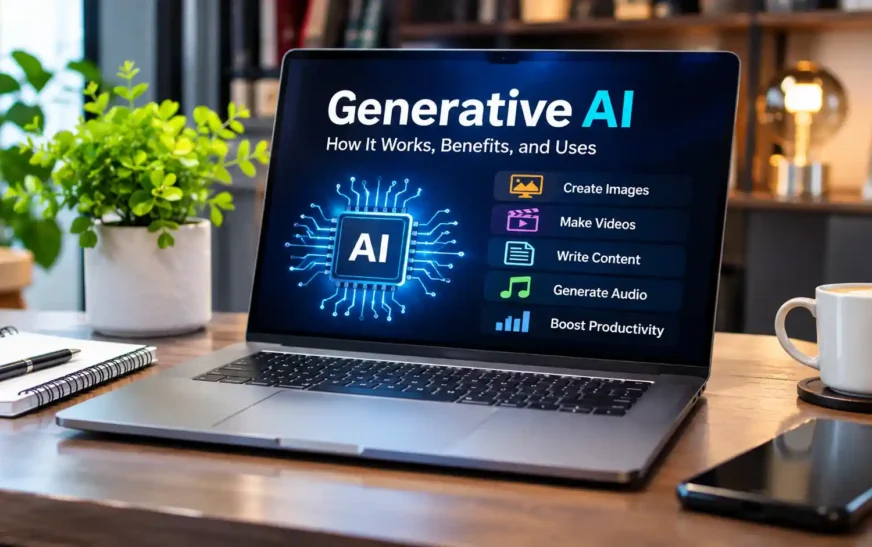
Generative AI is changing how people create content, solve problems, and complete everyday tasks. It is a type of artificial intelligence that can generate new text, images, videos, music, and computer code. Unlike traditional software that follows fixed instructions, generative AI learns patterns from large amounts of training data. It then uses these patterns to produce new outputs based on user requests. Today, students, businesses, marketers, and content creators use this technology for different purposes. Understanding generative AI can help you explore its benefits, recognise its limitations, and decide how to use it responsibly.
What Is Generative AI?
Generative AI refers to artificial intelligence systems designed to create new content from learned patterns. These systems can produce written answers, pictures, audio, videos, and other digital materials. Users usually interact with them through simple instructions called prompts. For example, someone can ask an AI tool to write a product description, explain a difficult topic, or suggest ideas for a blog post. The system processes the request and generates a response based on its training and design. Although the result may appear creative, the technology does not necessarily understand information in the same way humans do.
The main purpose of generative AI is to make content creation and information-based tasks easier. It can help people develop ideas, organise information, and produce first drafts more quickly. For instance, a small business owner might use an AI assistant to prepare product descriptions or customer service replies. A student might ask for a simple explanation of a science topic. However, generated information is not always correct, original, or suitable for every situation. Users should review important outputs before relying on them. Understanding both the technology’s capabilities and its limitations leads to better results.
How Does Generative AI Work?
Generative AI works by learning patterns and relationships from training data. During training, a model processes large collections of examples, such as text, images, audio, or code. The learning process helps it recognise how different elements relate to one another. A language model, for example, learns patterns in sentences and predicts which words or parts of words are likely to come next. Image generation models learn relationships between visual features and descriptions. After training, these systems can respond to new prompts and produce outputs that reflect patterns learned from their data.
When someone enters a prompt, the AI system processes the request and generates an output. The quality of that output often depends on the model, the available context, and the clarity of the instructions. For example, asking for a general article about healthy eating may produce broad advice. Providing a specific audience, topic, tone, and structure can produce a more useful draft. However, a detailed prompt cannot guarantee factual accuracy. Some systems may invent details or misunderstand the request. Reviewing the result and correcting errors remain important parts of using generative AI effectively.
Common Types of Generative AI
Generative AI includes several types of tools designed for different kinds of content. Text generation systems can draft articles, answer questions, summarise documents, and help with writing. Image generators create pictures from written descriptions, while audio tools can produce speech, sound effects, or music. Video generation systems can create or modify video clips using text, images, or other inputs. Code generation tools help developers write, explain, and improve software. Each type serves different needs, so the best choice depends on the task, the desired output, and the level of human review required.
Some generative AI systems focus on one content type, while others support multiple formats. For example, a multimodal system may process text and images within the same conversation. A user could provide a picture of a broken household item and ask for possible explanations. Another user might submit a document and request a summary. These capabilities can make AI tools more flexible for personal and professional tasks. However, features vary between products, and not every model supports every input or output. Before choosing a tool, check its capabilities, privacy options, usage limits, and suitability for your intended work.
Benefits of Generative AI
One major benefit of generative AI is its ability to speed up many routine tasks. It can create first drafts, organise notes, suggest titles, summarise long text, and generate ideas in a short time. This support can help individuals spend less time on repetitive work and more time making decisions. For example, a marketing team can use AI to brainstorm campaign ideas before selecting and refining the strongest options. Teachers can also use it to develop practice questions and lesson materials. However, these benefits depend on the task, the quality of the instructions, and appropriate human supervision.
Another advantage is accessibility. People without advanced writing, design, or programming skills can use generative AI to explore tasks that might otherwise seem difficult. A beginner can request a simple explanation of a technical subject, while a small business owner can prepare a basic marketing plan. AI tools can also support translation, brainstorming, and personalised learning. Nevertheless, access to these capabilities does not remove the need for knowledge or judgment. Users still need to check facts, assess quality, and make suitable choices. Generative AI works best as a helpful assistant rather than a complete replacement for human thinking.
How Businesses Use Generative AI
Businesses use generative AI to support customer service, marketing, administration, product development, and internal communication. For example, a company may use an AI assistant to draft customer replies, prepare meeting summaries, or turn rough notes into clear reports. Marketing teams can generate ideas for advertisements, email campaigns, and product descriptions. Developers may use AI tools to explain code or suggest possible solutions to technical problems. These applications can improve productivity when they fit existing workflows. However, organisations should evaluate the results carefully, especially when tasks involve customers, financial information, legal matters, or confidential business records.
Small businesses can also use generative AI without building their own advanced systems. Depending on the available tools, owners may generate social media captions, prepare frequently asked questions, or plan blog content. An online shop could create an initial description for a new product and then edit it to match the actual item. A service provider might prepare a draft response to common customer enquiries. These examples show how AI can support everyday business activities. Still, companies should maintain a consistent brand voice, verify product details, and avoid sharing sensitive customer information with tools that are not approved for that purpose.
Generative AI for Content Creation and SEO
Content creators use generative AI to brainstorm topics, organise outlines, improve readability, and prepare initial drafts. For SEO work, it can suggest related questions, develop title ideas, and help explain complex subjects in simple language. A blogger might use AI to create an outline before adding personal experience, research, and useful examples. This approach can make the writing process more organised. However, publishing unedited AI content simply to increase the number of pages can result in weak material. Successful content should answer readers’ questions, provide accurate information, and offer clear value beyond repeating what already exists online.
Generative AI can also assist with technical and editorial SEO tasks. Depending on the tool, it may help draft meta descriptions, suggest internal link anchor text, or identify opportunities to improve headings. Website owners can use these suggestions as starting points rather than automatic decisions. For example, an AI-generated description should accurately represent the article and encourage relevant readers to visit the page. Content should also reflect the website’s purpose and demonstrate suitable expertise. If you are improving a WordPress website, explore our guide to on-page SEO and our WordPress SEO checklist for practical steps. Human editing remains essential for quality and trust.
Limitations and Risks of Generative AI
Despite its benefits, generative AI has important limitations. It can produce incorrect information, invent sources, misunderstand instructions, or present uncertain claims with confidence. These errors are sometimes called hallucinations. They can be especially serious when users rely on AI for medical, legal, financial, or other high-impact decisions. Generated images and videos may also contain visual mistakes or misleading details. Therefore, users should verify important claims using reliable evidence and qualified professionals where necessary. The technology can support research and planning, but its output should not automatically be treated as a trustworthy or complete answer.
Privacy, copyright, bias, and security are additional concerns. Depending on the service and its settings, information entered into an AI tool may be processed or stored in ways users should understand before sharing sensitive material. Training data can also contain social biases that affect generated responses. In addition, AI-created content may resemble existing work or raise questions about ownership and permission. Businesses should establish clear rules for using AI and protecting confidential information. Individuals should avoid uploading private documents without checking the relevant terms. Responsible use involves considering not only what AI can create but also the possible effects of using its output.
The Future of Generative AI
Generative AI is likely to remain an important part of digital technology as models and applications continue to develop. Improvements may make AI tools more useful for analysing information, understanding different media, and supporting complex workflows. People may increasingly use AI assistants to organise tasks, prepare documents, and interact with software. Businesses could also integrate generative systems into customer support and internal operations. However, the speed and direction of these changes will depend on technical progress, costs, regulations, and public trust. Future developments should therefore be considered carefully rather than treated as guaranteed outcomes.
As adoption grows, human skills will remain valuable. Clear communication, critical thinking, creativity, subject knowledge, and ethical judgment help people use AI more effectively. Someone who understands a topic can identify mistakes and improve generated content more easily than someone who accepts every answer without review. Education and workplace training can help users develop these skills. It is also important for organisations to explain when AI is used and establish suitable review processes. The most useful approach is to combine machine assistance with human responsibility. This balance can help people benefit from generative AI while managing its limitations.
Frequently Asked Questions
1. What Is Generative AI?
Generative AI is a type of artificial intelligence that creates new text, images, audio, videos, and other content.
2. How Does Generative AI Work?
It learns patterns from training data and uses those patterns to generate responses or content based on prompts.
3. What Are the Main Uses of Generative AI?
Common uses include writing, image creation, coding, summarisation, education, customer support, and marketing.
4. Is Generative AI Always Accurate?
No, it can produce incorrect information, so important facts should always be checked.
5. Can Beginners Use Generative AI?
Yes, beginners can use simple prompts to generate ideas, learn concepts, draft content, and complete everyday tasks.
Conclusion
Generative AI is transforming how people create content, learn new skills, and approach everyday work. From writing and image generation to business support and SEO, it offers practical ways to save time and explore ideas. However, it can also produce errors and raise concerns about privacy, bias, and responsible use. The best results come from combining AI assistance with human knowledge, careful checking, and clear goals. As the technology develops, understanding its strengths and limitations will become increasingly valuable. Start with a simple task, review the results carefully, and explore how generative AI can support your needs responsibly.