

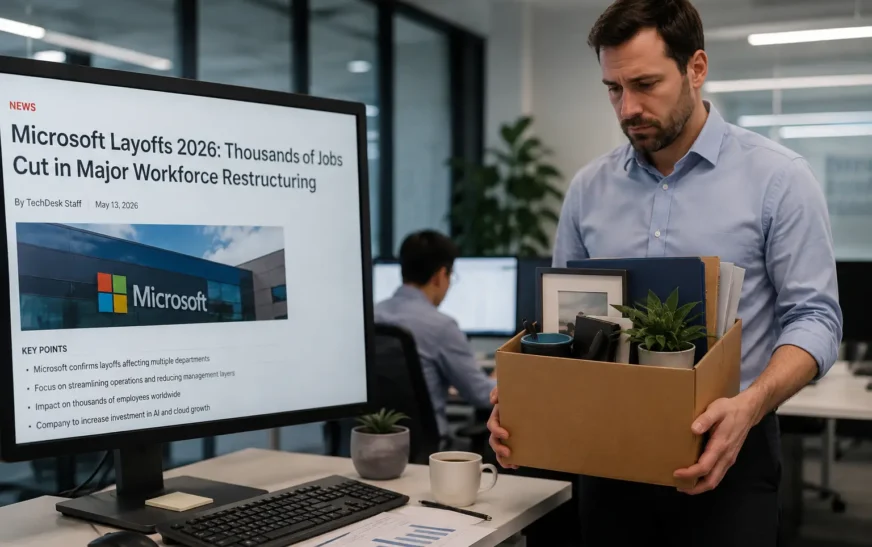
Microsoft layoffs remain a major topic in the technology industry after the company announced around 4,800 role eliminations on July 6, 2026, representing about 2.1% of its global workforce. The cuts were concentrated in Microsoft’s commercial business and Xbox, while the company continued investing heavily in artificial intelligence, cloud infrastructure and other growth areas.
The layoffs are part of a broader restructuring rather than evidence that Microsoft is shrinking across every part of its business. Microsoft reported $90.0 billion in revenue for the quarter ended June 30, 2026, up 18% year over year, while Microsoft Cloud revenue reached $59.3 billion.
Microsoft Layoffs 2026: The Key Facts
| Detail | What happened |
|---|---|
| Latest major announcement | July 6, 2026 |
| Jobs affected | About 4,800 roles |
| Share of global workforce | About 2.1% |
| Main areas affected | Commercial business and Xbox |
| Xbox cuts | About 3,200 roles as part of the restructuring |
| Immediate Xbox cuts | About 1,600 employees |
| Other workforce measures | Voluntary retirement and internal redeployment |
| Company’s stated reason | Restructuring, changing customer needs, business priorities and industry transformation |
| AI connection | Microsoft says AI is changing how work gets done, but the eliminated roles were not simply being replaced by AI |
Microsoft’s own July 6 announcement says the company had redeployed more than 4,000 employees into new roles over the preceding year and that more than 30% of eligible employees participated in its recent voluntary retirement program.
Why Is Microsoft Laying Off Employees?
Microsoft says the company is changing how it organizes its workforce because its industry, customers and business models are changing rapidly.
In its July announcement, Chief People Officer Amy Coleman said Microsoft’s priorities were shifting as technology becomes faster to build, deploy and use. The company said the latest changes were largely focused on its commercial organization and Xbox, with engineering teams also changing their structures and priorities.
AI is an important part of this environment, but it is too simplistic to describe every Microsoft layoff as an employee being replaced by an AI system.
Microsoft explicitly said the eliminated roles were not being replaced by AI. At the same time, the company acknowledged that AI is changing how work gets done and said it would continue investing in employee skills, including AI skills.
That distinction matters. The layoffs reflect a combination of workforce restructuring, changing business priorities, efficiency efforts and the company’s large investment in AI and cloud infrastructure. Read more : Best Miles Credit Card in Singapore: Top Travel Cards 2026
How Many Microsoft Employees Were Laid Off?
The July 2026 announcement involved approximately 4,800 roles, equivalent to about 2.1% of Microsoft’s global workforce.
Microsoft reported approximately 228,000 full-time employees as of June 30, 2025, including 125,000 in the United States and 103,000 internationally.
The latest cuts therefore represent a relatively small percentage of Microsoft’s overall workforce, even though the number of affected employees is significant.
It is also important to distinguish layoffs from other workforce changes. Microsoft’s 2026 restructuring included a voluntary retirement program and internal redeployment, meaning not every reduction in headcount came from involuntary layoffs. Microsoft said it had moved more than 4,000 employees into new roles during the preceding year.
Xbox Has Been Hit Particularly Hard
One of the most visible parts of the 2026 restructuring is Microsoft’s Xbox business.
Microsoft said approximately 3,200 jobs would be eliminated as part of the gaming division’s restructuring, including roughly 1,600 layoffs announced immediately. Reuters reported that the restructuring also involved plans to divest up to five studios.
The Xbox changes come after years of substantial investment in Microsoft’s gaming business, including the acquisition of Activision Blizzard.
The company is also changing its approach to gaming. Instead of relying primarily on console exclusives, Microsoft has increasingly focused on distributing games across multiple platforms. The restructuring is therefore about more than reducing employee numbers; it reflects a broader attempt to change how Xbox operates and generates returns.
What Happened to Microsoft’s Commercial Teams?
The July cuts were not limited to gaming.
Microsoft’s official announcement said the changes would mostly affect its Commercial and Xbox organizations. The commercial changes followed an announcement about its “Frontier Company,” which is intended to change how Microsoft works with customers and deploys engineering expertise.
This means Microsoft’s sales, commercial and customer-facing operations are also being reorganized as the company tries to align employees with areas it considers higher priority.
For employees and job seekers, this is an important point: the layoffs were not simply an Xbox story. The wider restructuring affects how Microsoft allocates people and resources across multiple parts of the business.
Microsoft’s AI Investment Helps Explain the Restructuring
Microsoft is investing heavily in AI at the same time it is reducing some areas of its workforce.
The company reported that Azure revenue surpassed $100 billion for the first time and that Microsoft 365 Copilot had more than 30 million paid seats by the end of fiscal 2026. Microsoft also reported Microsoft Cloud revenue of $59.3 billion for the quarter, up 27% year over year.
At the same time, Microsoft has been spending heavily to expand the computing capacity needed for AI services.
This creates an important business tension: Microsoft can be growing rapidly while simultaneously cutting jobs in particular organizations. Strong financial performance does not mean every department or business line needs to grow at the same rate.
Microsoft’s July 2026 earnings results illustrate this clearly. Revenue, operating income and net income all increased year over year, even as the company recognized severance expenses and charges associated with the Xbox restructuring.
Were There Microsoft Layoffs Before 2026?
Yes. The July 2026 reductions followed significant workforce changes during the previous fiscal year.
In July 2025, Microsoft CEO Satya Nadella publicly addressed recent job eliminations, describing them as difficult decisions occurring while the company was still growing and investing heavily. He said Microsoft’s overall headcount was relatively unchanged at that point, highlighting that workforce changes can occur even when a company’s overall business is expanding.
Microsoft’s workforce stood at approximately 228,000 full-time employees at the end of fiscal 2025, the same reported total as at the end of fiscal 2024.
The pattern shows why simply adding up individual layoff announcements can give an incomplete picture. Microsoft has also moved employees between organizations, offered voluntary retirement options and continued hiring or investing in strategic areas.
Does Microsoft Plan More Layoffs?
Microsoft has indicated that further organizational changes are possible.
In its July 6, 2026 employee communication, Microsoft said it was still early in the transformation and that other parts of the business would need to make similar changes. The company also said it would continue looking for alternatives to job eliminations where possible.
That does not mean Microsoft has announced a specific additional number of layoffs.
As of August 22, 2026, there is no reliable basis for claiming that a particular future number of Microsoft employees will be laid off. Workforce plans can change, and reports about possible cuts should be distinguished from confirmed company announcements.
Microsoft’s fiscal 2026 third-quarter earnings call had already indicated that headcount was expected to decrease year over year as the company evolved its operating model while continuing investments in research and development, including AI.
What Do the Layoffs Mean for Microsoft Employees?
For affected employees, the immediate consequences depend on their location, role, employment terms and the specific restructuring.
Microsoft says it provides financial support and resources to employees whose roles are eliminated. The company has also emphasized redeployment where possible and continued investment in new skills, including AI.
For employees who remain at Microsoft, restructurings can mean changes in reporting lines, responsibilities, teams and priorities.
The company’s emphasis on AI also suggests that some roles may increasingly require employees to work with AI tools rather than compete directly with them. Microsoft’s July announcement specifically mentioned equipping employees with new skills as part of its response to the changing nature of work.
What Do Microsoft Layoffs Mean for the Tech Job Market?
Microsoft’s layoffs are part of a wider technology-industry trend in which companies are trying to balance traditional workforce costs with enormous investment in AI infrastructure.
The important lesson for technology workers is that strong demand for AI does not necessarily translate into more jobs across every technology category. Companies may reduce positions in some functions while aggressively investing in others.
For job seekers, skills connected to cloud computing, cybersecurity, data, AI development, AI infrastructure and the practical deployment of AI systems may become increasingly important. However, it would be misleading to say that every worker needs to become an AI engineer.
The broader shift is toward organizations wanting employees who can use new technology to produce measurable business results.
What Microsoft Layoffs Mean for the Company
The restructuring suggests that Microsoft is trying to make its workforce match its changing investment priorities.
Three themes stand out:
AI and cloud investment: Microsoft continues to spend heavily on infrastructure, AI products and related research and development.
Organizational efficiency: Microsoft is reducing or restructuring positions in areas where leadership believes the current organization is not aligned with future priorities.
Gaming transformation: Xbox is undergoing one of the most significant parts of the restructuring, with thousands of roles affected and changes to the studio portfolio and business model.
The result is a company that can simultaneously be expanding financially and shrinking headcount in selected areas.
Microsoft Layoffs vs. Microsoft Business Growth
It may seem contradictory for a company to report strong growth while cutting thousands of jobs. In Microsoft’s case, both things are happening.
The company reported 18% year-over-year revenue growth to $90.0 billion in its fiscal fourth quarter of 2026. Operating income increased 18%, while GAAP net income rose 31%.
These figures show why layoffs should not automatically be interpreted as a sign that Microsoft is in financial trouble.
Instead, the company is reallocating resources. Some businesses and technologies are receiving greater investment, while other teams are being reduced, reorganized or asked to operate differently.
That is a common feature of large technology companies undergoing major strategic transitions, but it does not make the effect on affected employees any less significant.
What Job Seekers Should Know About Microsoft After the Layoffs
Anyone considering a Microsoft career should avoid assuming that layoffs mean the company has stopped hiring.
A better approach is to examine the areas where Microsoft is continuing to invest. Its latest financial results show continued emphasis on cloud and AI, while its organizational announcements point to changing commercial, engineering and gaming structures.
Applicants should also pay attention to the exact job description rather than relying on Microsoft’s overall hiring reputation.
Skills that demonstrate the ability to work with cloud platforms, AI-enabled products, security, data or customer transformation may be particularly relevant to the company’s current direction, although individual hiring needs vary by team and location.
The Bottom Line on Microsoft Layoffs
The latest Microsoft layoffs involved about 4,800 roles announced on July 6, 2026, or roughly 2.1% of Microsoft’s global workforce. Xbox and commercial operations were among the areas most affected, with the Xbox restructuring accounting for about 3,200 positions.
The company has connected the restructuring to changing customer needs, business priorities, organizational efficiency and the rapid transformation of the technology industry. AI is an important part of that transformation, but Microsoft has said the eliminated roles were not simply being replaced by AI.
As of August 22, 2026, Microsoft continues to report strong financial and cloud growth while reorganizing selected parts of its workforce. The clearest picture is therefore not one of a company simply shrinking, but of a large technology company moving people and investment toward areas it believes will drive its next phase of growth.
FAQ
How many people did Microsoft lay off in 2026?
Microsoft announced about 4,800 role eliminations on July 6, 2026, equal to approximately 2.1% of its global workforce.
Why is Microsoft laying off employees?
Microsoft says its business is changing because customer needs, technology, business models and the way work is performed are changing. The company is restructuring its commercial and Xbox organizations and adjusting engineering teams while continuing major investments in AI.
Is Microsoft replacing employees with AI?
Microsoft has said the roles eliminated in the July 2026 restructuring were not being replaced by AI. However, the company also acknowledges that AI is changing how work gets done and is investing in AI-related employee skills.
How many Xbox employees were affected?
The Xbox restructuring involves about 3,200 job cuts, including approximately 1,600 employees affected immediately when the July 2026 announcement was made.
Will Microsoft have more layoffs?
Microsoft said in July that it expected more organizational changes and that other parts of the business would need to make similar adjustments. However, Microsoft has not publicly confirmed a specific future number of layoffs, so claims about an exact additional total should be treated cautiously.
Is Microsoft still growing despite the layoffs?
Yes. Microsoft reported $90.0 billion in fiscal fourth-quarter revenue for the quarter ended June 30, 2026, up 18% year over year. Microsoft Cloud revenue reached $59.3 billion, up 27%.